The short answers
What type of flooring is popular in 2026?
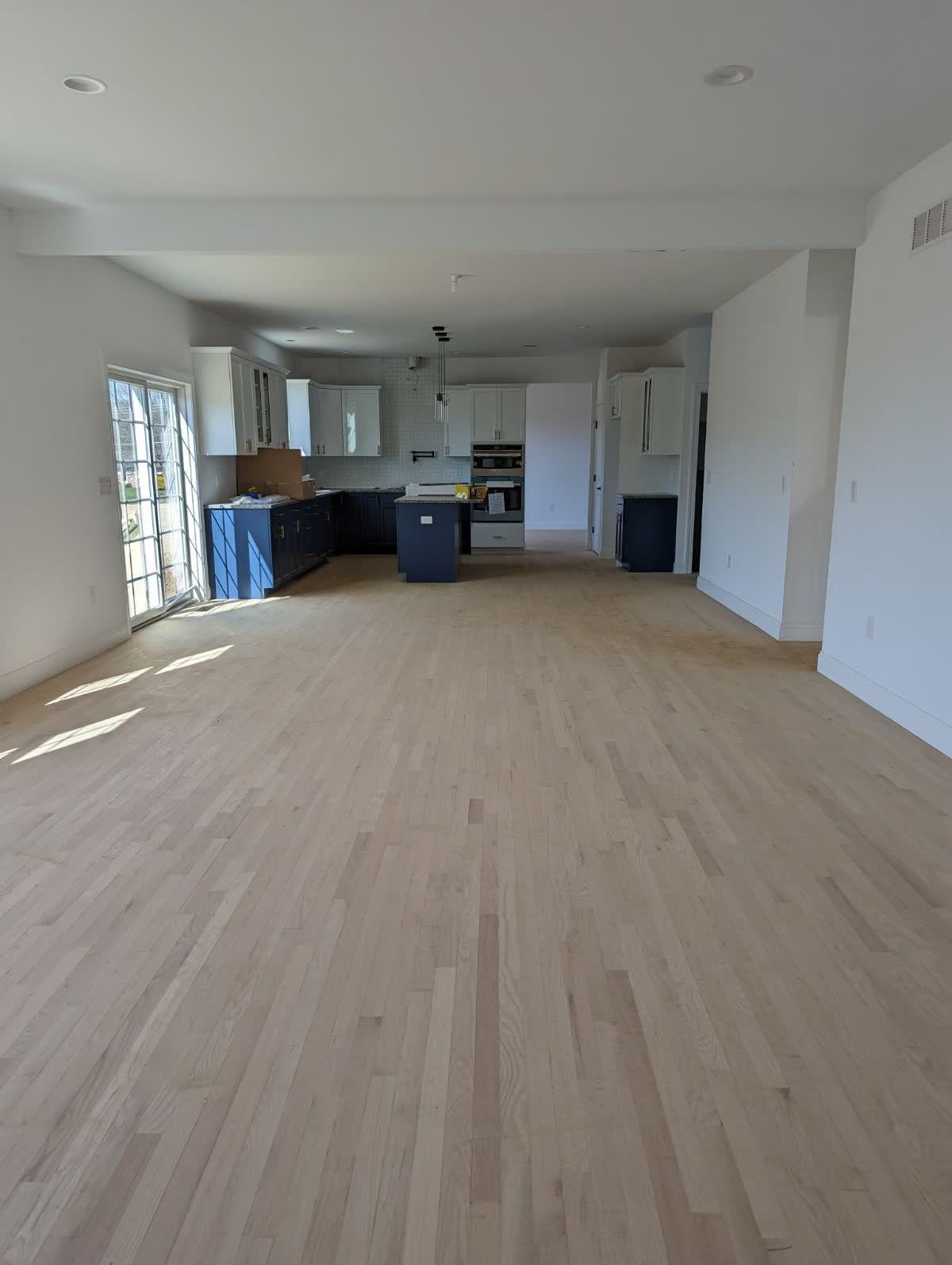
Two things at once. Warm-toned wood, especially natural white oak and refinished red oak in 5 to 7 inch planks with a matte finish, is the look people ask for. Rigid-core luxury vinyl plank is what the industry sells the most of by dollars, at 36.5 percent of all flooring sold in the United States in 2025. The winning house uses both: wood on the main living level, rigid core in basements, mudrooms and laundry rooms.
What flooring will not go out of style?
A site-finished or prefinished oak floor in a natural to medium-brown tone, laid in a plain plank of 4 to 7 inches, with a low-sheen finish. It has been the safe answer for a century because it can be sanded and recolored when tastes shift. Honed porcelain or natural stone in wet rooms is the second timeless choice.
What flooring trends are replacing outdated styles?
Warm honey and mid-brown tones are replacing cool gray and whitewashed floors. Wide, long planks are replacing narrow strip. Matte and satin are replacing gloss. Patterned layouts, herringbone and chevron in particular, are replacing plain planks in entries and dining rooms. And refinishing an existing floor is replacing tear-out as the default first move.
What are the trendy colors for hardwood flooring in 2026?
Natural white oak with no stain or a clear waterborne finish, soft honey and wheat tones, and warm mid-browns that read like walnut or fumed oak. Deep espresso is back in small doses on stairs and feature rooms. Gray, driftwood and heavy whitewash are the colors homeowners are now paying to remove.
What people are actually buying, with the numbers
Trend articles usually skip the sales data. It matters, because what sells tells you what will still be supported, stocked and repairable in ten years. These figures come from the two flooring trade publications that track the United States market and from a 2026 homeowner survey commissioned by the finish maker Bona. Links are in the sources.
- 36.5% Vinyl's share of all United States flooring dollars in 2025, up from 35 percent in 2024 and 34 percent in 2023.Floor Covering News, "Stats 2026: Rigid core products continue to dominate sales"
- 24.4% Luxury vinyl tile and plank alone as a share of floor-covering dollars, and 29.3 percent of square feet sold.Floor Covering Weekly, Catalina Research, "Resilient's Steady Rise"
- 3 in 4 Rigid-core products now make up more than three quarters of luxury vinyl sold, and about 58 percent of the whole resilient category.Floor Covering Weekly and Floor Covering News, 2026
- $1.77B Hardwood flooring sales in 2025, on 630 million square feet, down 3.8 percent in dollars and 6.8 percent in volume. The lowest since 2012 and 33.6 percent below the 2021 peak.Floor Covering News, "Scoring Flooring: Industry stats for 2025"
- 80.3% Share of hardwood flooring that goes into homes rather than commercial space. Wood is a residential product, and 36.4 percent of it goes into new construction.Floor Covering Weekly, Catalina Research, "2025 Sales Slide Further Down"
- 61% Homeowners who said wood flooring was a priority in their home, and 75 percent said they would rather restore an existing wood floor than replace it.Bona 2026 homeowner survey, reported by Forbes
- 89%+ Reduction in emissions from refinishing a hardwood floor instead of replacing it, in a life-cycle study commissioned by Bona.Bona and IVL Swedish Environmental Research Institute, reported by Forbes
Read those together and the 2026 story is clear. Vinyl keeps winning volume because it is cheap to buy and forgiving to live on. Wood keeps winning desire, but fewer people are buying new wood, and more are paying to bring old wood back. For a homeowner in Ewing, Hamilton, Lawrence or Hopewell, where a large share of houses already have oak under the carpet, that second fact is the money-saving one.
1. Warm wood tones replace gray
The gray floor era is over. The floors people photograph now are natural white oak, honey and wheat tones, and warm mid-browns. In our own work the request has flipped completely: the same customers who asked for driftwood in 2019 now ask us to sand it out.
Why it happened is simple. Gray was a stain fighting the wood. Oak is naturally warm, and a gray or whitewash finish sits on top of that warmth like a filter. As soon as walls moved to warm whites and creams, gray floors started to look dirty. Natural finishes let the wood be the wood.
Species matters more than stain now. White oak takes a clear waterborne finish and stays pale and even. Red oak, which is what most Mercer County houses built before 2000 have, carries a pink undertone. A neutral toner or a light brown stain pulls it warm without turning it orange. If you want the pale, even Scandinavian look on existing red oak, ask about a whitening bond coat before the clear coats. It is a finishing step, not a new floor.
Where it fits: whole main levels, open kitchens, anywhere the walls are warm white or greige. Where to be careful: north-facing rooms with little daylight, where a very pale natural oak can read flat. A half-shade warmer stain fixes that.
Related service: hardwood flooring and floor sanding and refinishing.
2. Wide planks and long boards
The National Wood Flooring Association calls anything under 3 inches strip, 3 to 5 inches plank, and over 5 inches wide plank. In 2026 the demand is squarely in wide plank, 6 to 8 inches, with long lengths and few short pieces. Fewer seams make a room feel larger and calmer, which is why this pairs so naturally with the warm, matte look above.
Wide boards move more, and in New Jersey they move twice a year. Wood shrinks and swells across the grain as its moisture content changes, and the wide face of a flatsawn board moves roughly twice as much as its edge. The Forest Products Laboratory puts red oak's tangential movement at about 0.0037 inch per inch of width for every one-point change in moisture content. On a 7 inch plank, a four-point seasonal swing is about a tenth of an inch of movement per board. Across a 12 foot wide room that adds up to more than an inch and a half of total movement showing up as winter gaps or summer pressure.
That is why wide solid plank gets a tighter moisture spec. The NWFA guideline allows a 4 point difference between solid strip flooring and a wood subfloor, but only 2 points for boards 3 inches and wider. Wide solid boards also get glue-assist along with nails to control cupping. Over a basement slab or with radiant heat, we steer toward engineered wide plank, which keeps the look with a fraction of the movement.
Where it fits: great rooms, open kitchens, primary bedrooms. Where to be careful: any floor over a slab or a damp crawlspace, and any house without humidity control. See the New Jersey section below before you commit to 8 inch solid boards.
3. Herringbone, chevron and checkerboard
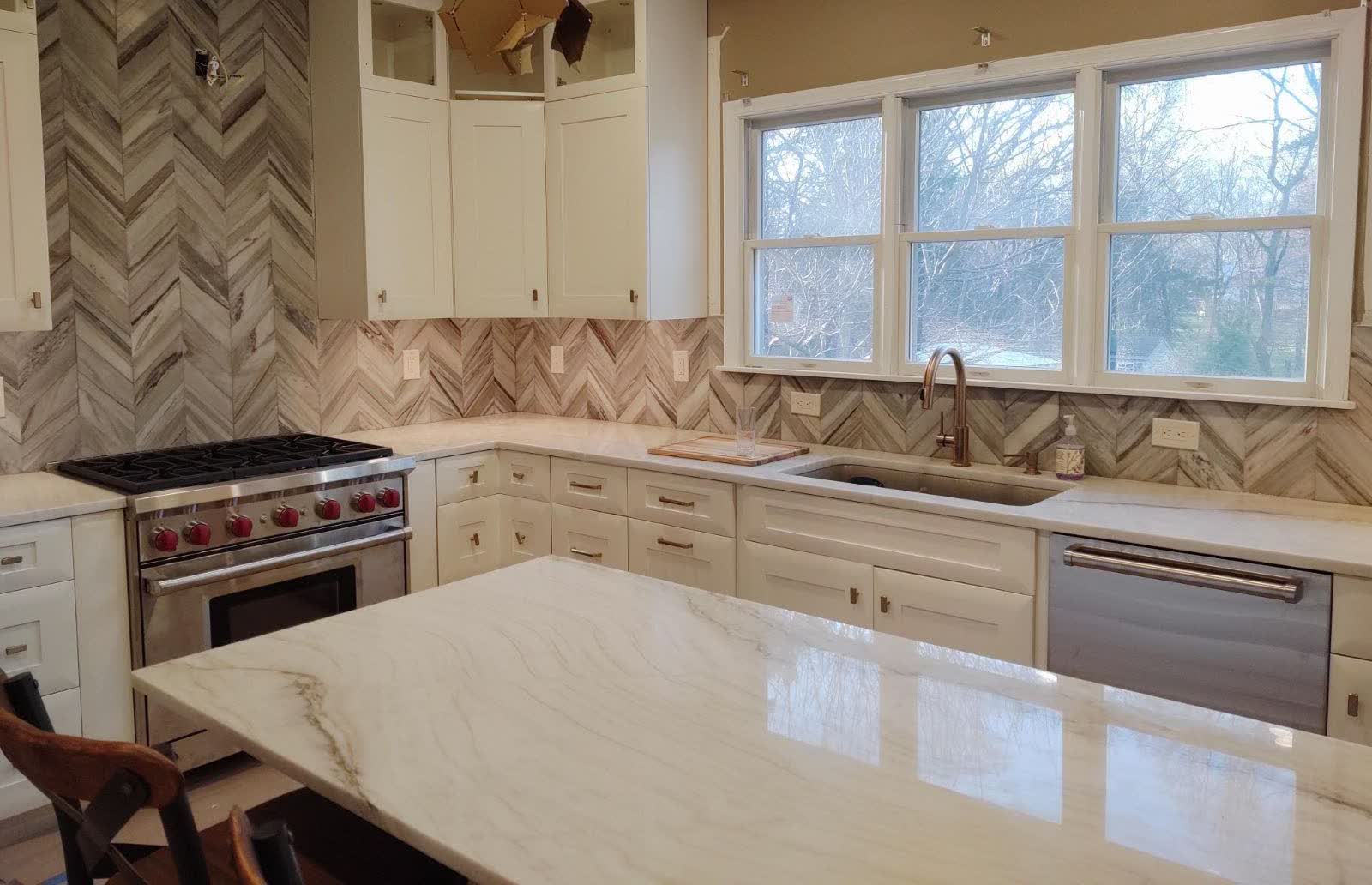
Pattern is the one 2026 trend that is genuinely new for most homeowners. Herringbone, where rectangular boards meet at a right angle, and chevron, where the ends are mitered so the pattern forms a clean V, have moved from Paris apartments into New Jersey entries, dining rooms and kitchens. In tile, the checkerboard is back, usually in honed stone or matte porcelain in two soft tones rather than hard black and white.
Pattern is a layout job before it is a flooring job. The centerline has to be dead straight and square to the room's dominant sightline, usually the front door or the kitchen island, or the eye catches the drift immediately. Expect a higher material allowance because every board along the walls is cut. Chevron costs more than herringbone because the miters are cut at the mill or on site and the boards cannot be flipped. Both patterns demand a flatter subfloor than a plain plank floor, and both go down faster and straighter as an engineered glue-down than as a solid nail-down.
Where it fits: entries, dining rooms, a kitchen floor framed by plain plank in the adjoining rooms, stair landings. Where to be careful: long narrow hallways, where the pattern fights the room. Related service: tile and backsplashes and natural stone.
4. Rigid-core vinyl keeps growing, but as a room-by-room choice
Rigid-core luxury vinyl plank is the volume story of the decade, and 2026 is no different. It is waterproof, it goes over imperfect subfloors, and it survives dogs, kids and wet boots. It is also on two of the top ten trend pages for this year as a look that is going out. Both things are true. Vinyl as a whole-house default is losing favor with buyers who can tell it from wood. Vinyl in the right rooms is more popular than ever.
Three things decide whether a rigid-core floor looks expensive or cheap. First, subfloor flatness: rigid core telegraphs every hump and dip, so the slab or plywood has to be flattened first. Second, expansion: it is a floating floor and needs its gap at every wall and a transition at long runs and doorways, or it will buckle in a hot July. Third, sunlight: a south-facing room with a sliding door can heat a dark vinyl floor enough to move it. Pick a plank with a thicker wear layer, a matte embossed-in-register texture, and a color that matches the real wood in the rest of the house.
Where it wins: finished basements, mudrooms, laundry rooms, rental units, and anywhere over a slab. Where it loses: the main living level of an older Ewing or Trenton-area house that has original oak under the carpet. Refinishing that oak is usually the better investment. Related service: luxury vinyl and LVP.
5. Matte and low-sheen finishes
Gloss is gone. Matte and satin finishes dominate both prefinished and site-finished wood in 2026, and the same is true of tile, where honed stone and matte porcelain have replaced polished surfaces in most kitchens and baths.
Matte is practical, not just fashionable. It hides micro-scratches, dust and footprints far better than semi-gloss. For site-finished floors we favor two-component waterborne finishes: they stay clear instead of ambering, cure faster than oil-based polyurethane, and keep the natural white oak look people are asking for. Satin is the compromise if you worry that full matte looks unfinished. Hardwax oils give the most natural hand feel but need periodic maintenance coats, so they suit owners who will keep up with them.
Where to be careful: matte finishes show water spots on very dark stains. On a deep espresso stair or feature room, satin is the safer sheen.
6. Refinish before you replace
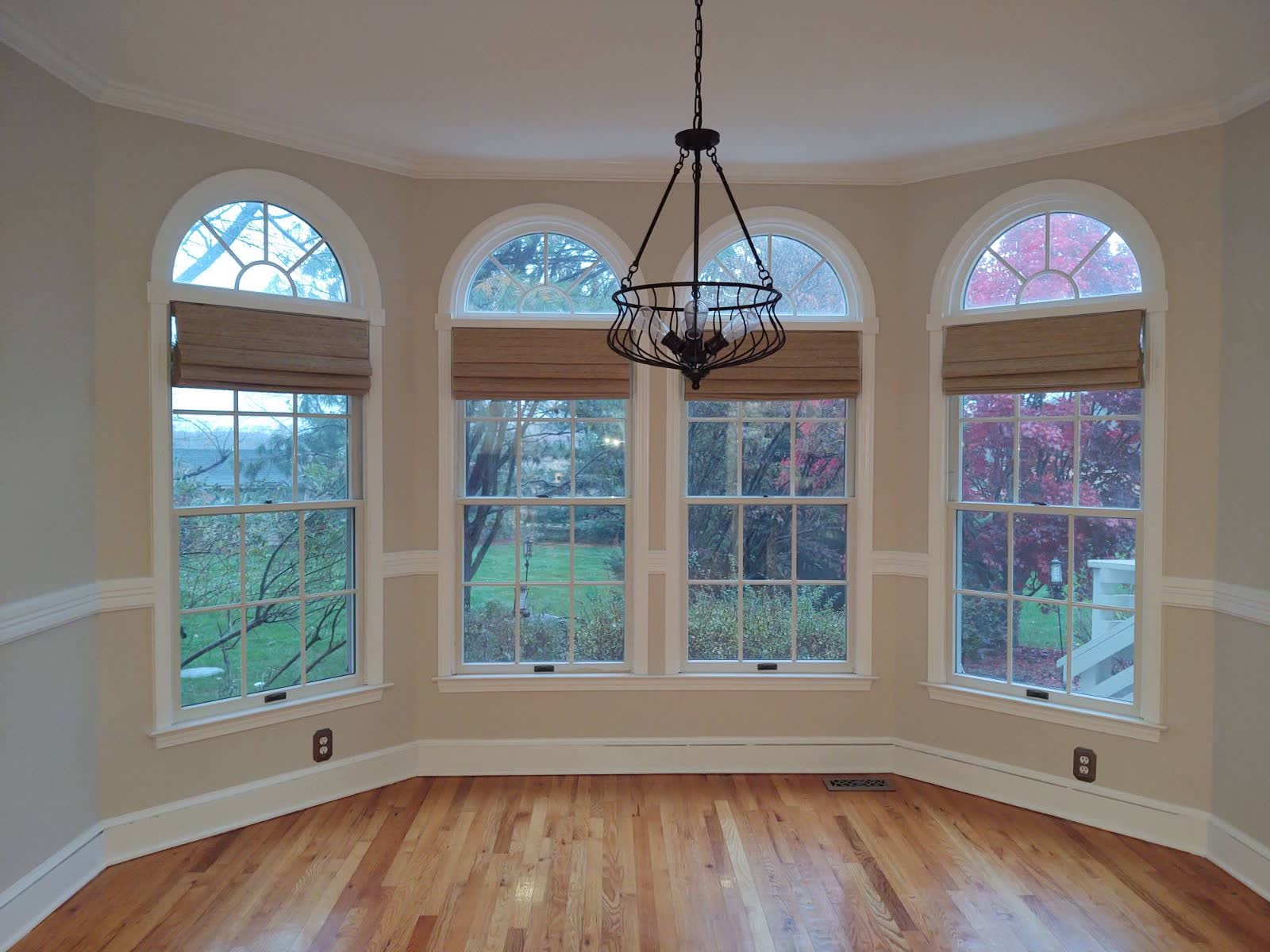
With three quarters of homeowners preferring to restore rather than replace, and refinishing cutting the environmental cost by more than 89 percent, restoration is the quiet trend of 2026. It is also the most New Jersey trend on this list. A large share of the housing stock in Mercer, Burlington and Bucks counties was built with solid oak floors, and most of that oak has been sanded at most once or twice.
A solid three-quarter-inch oak floor can typically be sanded several times over its life, and each full sanding removes only a small fraction of the board. The floors we cannot save are the ones with active water damage, severe cupping that has already been sanded flat once, or an engineered top layer too thin to cut. If your floor has been sanded more than a few times, look at the exposed tongue at a heat register: if there is little wood left above it, it is time to talk about new boards. Everything else, including pet stains, gray stain, orange polyurethane and squeaks, is a refinishing conversation.
Related service: floor sanding and refinishing. Start with the residential flooring page if you are weighing refinish against new.
7. Large-format tile and real stone
In kitchens and baths, the 2026 look is fewer grout lines and softer surfaces: 24 by 48 inch porcelain that reads like limestone or travertine, honed marble in a checkerboard or chevron, and real natural stone used as a feature on a wall, a shower, or a fireplace surround.
Large-format tile is unforgiving of a wavy floor. A 48 inch tile spans humps that a 12 inch tile would ride over, so the substrate is flattened or self-leveled first, and a medium-bed mortar and leveling clips control lippage. Natural stone needs sealing and a gentler cleaner than porcelain, and some marbles etch from lemon juice and vinegar, which matters on a kitchen floor. Both work well over radiant heat.
Related services: tile and backsplashes and natural stone.
What's on the way out in 2026
- OutGray, driftwood and heavy whitewash stains, on wood and on wood-look vinyl alike.
- OutHigh-gloss finishes and polished marble floors in high-traffic rooms.
- OutNarrow strip in an orange-toned finish, the default of the 1990s and 2000s. Refinishable, not disposable.
- OutA different floor in every room. Buyers want one floor running through the main level.
- OutLuxury vinyl plank as a whole-house default in houses that already have hardwood.
- FadingWall-to-wall carpet on main levels. It is returning, softly, as a comfort layer in bedrooms only.
The New Jersey part nobody covers: humidity, heat, and the install window
Every national trend list skips the one variable that decides whether your wood floor succeeds: the air in your house across a year. In central New Jersey that variable swings hard.
Ewing sits in what the Office of the New Jersey State Climatologist at Rutgers calls the Central Zone, a band running from New York Harbor to the great bend of the Delaware River near Trenton. The central portion of the state averages 15 to 20 days a year above 90 degrees. Every long-running station in New Jersey has recorded both 100 degrees or hotter and zero or colder. Most of the state gets 43 to 47 inches of precipitation a year, spread over roughly 120 days with measurable rain or snow. Summers are humid; winters, once the furnace runs, are dry.
Wood does not care about temperature nearly as much as it cares about moisture. Below its fiber saturation point, wood takes on and gives up water with the surrounding air until it reaches equilibrium, and it swells and shrinks as it does. Flatsawn white oak can shrink about 10.5 percent across its width from green to oven-dry, roughly twice its radial movement. A finished floor never sees that range, but it does see a summer-to-winter swing, and a wide plank shows every point of it.
What that means for your install
- Get the house to living conditions first. The NWFA guideline is that the building is enclosed, at normal living temperature and humidity, and that the heating or cooling system has been running for at least five days before wood flooring arrives. A floor delivered into a house with fresh drywall mud and no air conditioning in August is being set up to shrink in January.
- Acclimate to the target, not to the room. Acclimation is not a fixed number of days. The goal, per the Forest Products Laboratory, is to install wood at a moisture content that matches the average conditions it will live in. In a New Jersey house held between 30 and 50 percent relative humidity, that usually lands between 6 and 9 percent moisture content. We verify with a meter, not a calendar.
- Meter the boards and the subfloor. NWFA calls for checking roughly 40 boards per 1,000 square feet. Solid strip under 3 inches can be within 4 points of a wood subfloor; boards 3 inches and wider must be within 2 points. Those two numbers are the difference between a flat floor and a cupped one.
- Test concrete slabs, do not eyeball them. Below-grade or slab-on-grade floors in a Delaware Valley basement get an in-situ relative humidity probe test to ASTM F2170 or a calcium chloride vapor emission test to ASTM F1869 before anything goes down. Failing numbers mean a moisture mitigation coating, or a switch to rigid core or engineered flooring rated for the reading.
- Plan for the season you are installing in. A floor installed in a humid July is installed at its widest; leave it slightly tighter and it will still open a hairline in winter. A floor installed in a dry February is at its narrowest; it needs its full expansion gap or it will pressure the walls by August. Neither is a defect. Both are predictable.
- Control the air after we leave. The best thing you can do for a wide-plank floor in New Jersey is keep the house between 30 and 50 percent relative humidity year round: dehumidify the basement in summer, humidify in winter. That single habit prevents most of the gapping and cupping calls we get.
This is also why we do not sell the same floor into every house. A 1950s Ewing ranch with a dry crawlspace, a 1920s Trenton twin with a fieldstone basement, and a 2015 Hopewell colonial with a sealed slab are three different moisture stories, and they get three different recommendations.
What will not go out of style
If you want one answer to give a spouse or a realtor, here it is: a natural to medium-brown oak floor, 4 to 7 inches wide, plain plank, low sheen, run in one direction through the main level. It looked right in 1926, it looks right in 2026, and if tastes shift in 2036 it can be sanded and recolored for a fraction of the cost of a new floor. That refinishability is the whole reason it is timeless. Vinyl, laminate and prefinished floors with thin wear layers cannot make that promise.
- Oak, plain plank, warm neutral tone, matte or satin. The safest floor in New Jersey.
- Honed porcelain or natural stone in bathrooms, mudrooms and laundry rooms.
- A simple, well-built hardwood stair that matches the floor. See stairs.
- Neutral, dense carpet in bedrooms, where comfort beats fashion. See carpet.
Cost and durability, side by side
Relative costs below are installed, in the same house, compared against a plain prefinished engineered oak floor as the baseline. Exact numbers depend on the subfloor, the room shapes and the product, which is what a free estimate pins down.
- Refinishing existing solid oak. Lowest cost of anything on this page when the boards are sound. Durability of the original floor, with a new finish. Best value in most pre-2000 houses.
- Rigid-core luxury vinyl plank. Low to mid material cost, fast install, waterproof. Cannot be refinished; a damaged plank is replaced. Wear layer thickness determines how many years it looks new.
- Prefinished engineered oak, plain plank. The baseline. Stable over slabs and radiant heat. Refinishable once or twice if the wear layer is thick enough.
- Site-finished solid oak, plain plank. Mid to upper cost, longest service life, fully refinishable. Needs the moisture discipline described above.
- Wide-plank solid or engineered, 7 inches and up. Higher material cost per square foot and more waste. Same durability as the narrower version of the same product, with more seasonal movement.
- Herringbone or chevron in wood. Highest labor and material allowance of the wood options. Durability identical to the same product in plain plank.
- Large-format porcelain. Mid to upper cost, driven by substrate preparation. Effectively permanent, waterproof, cold underfoot without radiant heat.
- Natural stone. Highest material cost, needs sealing and gentle care. Ages beautifully if you accept patina.
Looking ahead to 2027
Searches for 2027 flooring trends are already rising, so here is our read. This is an outlook from what we are quoting and installing today, not a forecast from a manufacturer.
- Warm goes deeper. The natural white oak look holds, but the second color in the house shifts from pale to a true medium brown: fumed oak, walnut tones and warm espresso on stairs.
- Mixed widths and long lengths. Random-width plank, 4, 6 and 8 inches together, returns as a way to get the wide-plank calm with a little more character and less movement per board.
- Refinishing keeps taking share from replacement. With new hardwood volume at its lowest since 2012 and most homeowners preferring restoration, the growth in wood is in sanding, toning and finishing what is already there.
- Rigid core matures rather than grows. Expect thicker wear layers, better wood-matched textures and more honest marketing, with share leveling off rather than climbing another point a year.
- Pattern moves into tile. Checkerboard and chevron in honed stone and matte porcelain in kitchens, mudrooms and baths, softer than the black-and-white version.
- Low-VOC, waterborne and refinishable become selling points. Health and longevity claims will matter more than "waterproof" on the next generation of product labels.
How to choose for your house
- Find out what is under the carpet. Lift a corner in a closet. If it is oak, start with a refinishing quote.
- Sort rooms by moisture: main level and bedrooms in one group; basement, mudroom, laundry, and baths in another. Wood goes in the first, rigid core, tile or stone in the second.
- Pick one floor for the whole main level and one tone family for the house, then let pattern live in one room, an entry or a dining room.
- Match the width to the house. A 1950s ranch with 8 foot ceilings reads better in 5 inch plank than 8 inch; a great room with 10 foot ceilings can carry 7 to 8 inch boards.
- Choose matte or satin, warm neutral, and a species you can refinish. That decision alone keeps you out of the next "trends that are out" article.
- Ask for moisture readings in writing, for the subfloor and the boards, before the first board goes down. Any installer working in New Jersey should be glad to show them.
Ready to price it? Start with the residential flooring overview, browse our past work, or go straight to a free estimate.
Questions we hear on estimates
Is luxury vinyl plank out of style in 2026?
As a whole-house default in a house that already has hardwood, yes, buyers increasingly notice it. In basements, mudrooms, laundry rooms and rentals, no. It is the most-sold flooring in the country and the right product for wet and below-grade rooms.
Are gray floors out?
Yes. Gray and driftwood stains are the color homeowners are now paying to sand out. If you have a gray solid oak floor, it can be refinished to a natural or warm tone without replacing a board.
What is the best flooring for a New Jersey basement?
Rigid-core luxury vinyl plank or porcelain tile over a tested slab. Solid hardwood is not recommended below grade. Engineered wood is possible only when the slab passes an ASTM F2170 or F1869 moisture test and the product is rated for it.
When is the best time of year to install hardwood in New Jersey?
Any month works when the house is conditioned and the wood is metered, but the easiest installs happen in spring and fall when indoor humidity is near the yearly average. Summer installs need the air conditioning and a dehumidifier running ahead of delivery; winter installs need the full expansion gap.
Can I refinish my floors instead of replacing them?
Usually. Solid oak that is dry, flat and has meaningful wood left above the tongue can be sanded, recolored and finished. Water-damaged boards, badly cupped floors that were already sanded flat once, and thin engineered wear layers are the exceptions. We tell you which one you have on the estimate visit.
What wood floor color is most popular in 2026?
Natural white oak with a clear matte waterborne finish. Second is a warm honey or light brown tone, and third is a medium walnut-brown. On existing red oak, a neutral toner that cancels the pink is the most requested refinish color.
Do wide planks gap in winter?
Every wood floor moves seasonally in New Jersey; wide planks show it more because each board moves in proportion to its width. Hairline winter gaps that close in summer are normal. Large gaps or cupping mean the boards, the subfloor or the house humidity were off at install, which is why we meter all three.
Sources
- National Wood Flooring Association, Installation Guidelines (board width categories; jobsite conditions and HVAC operating at least five days before installation; moisture checks of about 40 boards per 1,000 square feet; 4 point and 2 point flooring-to-subfloor moisture limits).
- USDA Forest Service, Forest Products Laboratory, Wood Handbook, Chapter 4: Moisture Relations and Physical Properties of Wood (equilibrium moisture content; tangential shrinkage roughly twice radial; white oak tangential shrinkage about 10.5 percent).
- USDA Forest Service, Forest Products Laboratory, Research Paper FPL-RP-711 (dimensional change coefficients; red oak tangential 0.0037 per one point of moisture content, valid between 6 and 14 percent).
- USDA Forest Service, Forest Products Laboratory, Wood Handbook, Chapter 12: Drying and Control of Moisture Content (install wood at the moisture content matching average in-service conditions).
- ASTM International, ASTM F2170, in-situ relative humidity testing of concrete slabs, and ASTM F1869, calcium chloride moisture vapor emission rate testing.
- Rutgers University, Office of the New Jersey State Climatologist, Climate Overview of New Jersey (Central Zone boundaries, days above 90 degrees, temperature extremes, precipitation totals and frequency).
- Floor Covering News, Stats 2026: Rigid core products continue to dominate sales, July 1, 2026 (vinyl share of flooring dollars; resilient share of hard surface; rigid core share of resilient).
- Floor Covering News, Scoring Flooring: Industry stats for 2025, June 29, 2026 (hardwood dollars and square feet, 2025 versus 2024 and the 2021 peak).
- Floor Covering Weekly, Resilient's Steady Rise, July 29, 2026, citing Catalina Research (luxury vinyl share of dollars and square feet; rigid core share of luxury vinyl).
- Floor Covering Weekly, 2025 Sales Slide Further Down, July 27, 2026, citing Catalina Research (wood share of dollars and square feet; residential and builder shares).
- Forbes, 2026 Home Flooring Trends: Patterned Hardwoods And Toasty Palettes, February 25, 2026 (Bona homeowner survey figures and the Bona and IVL refinishing life-cycle study).
Project photographs on this page are from our own installations. Market figures are for the United States as reported by the sources above; New Jersey figures are not published separately. Installer guidance reflects the cited industry standards and our field practice in central New Jersey and nearby Pennsylvania.